Western Reserve Land Conservancy is the largest land trust in Ohio and one of the largest land trust organizations in the nation. It was created in 2006 through the largest ever merger of land trusts in the United States after eight northern Ohio land trusts joined forces to form a private, nonprofit conservation organization for a region stretching from Sandusky Bay to the Pennsylvania border and from Lake Erie to Wayne County.
Four years later, the Land Conservancy grew again by merging with Grand River Partners and at the start of 2013, two more conservation groups joined: the Waite Hill Land Conservancy and the Little Beaver Creek Land Foundation.
Today, Western Reserve Land Conservancy is the result of the merger of 13 organizations and its 29-county footprint now extends south to Columbiana, Jefferson and Carroll.
As of May 2026, 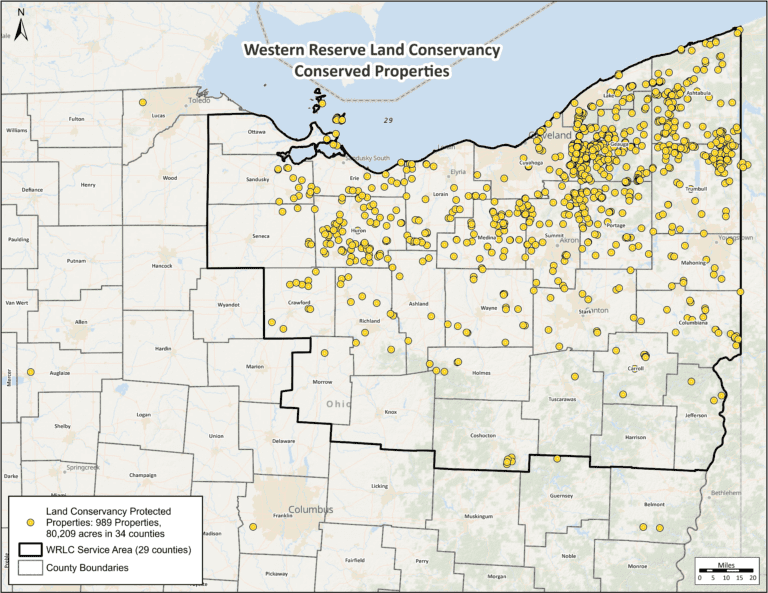 the Land Conservancy had permanently conserved 989 properties and approximately 80,209 acres in northern Ohio, and helped create 250 public parks and preserves totaling 21,312 acres. The Land Conservancy has also been instrumental in creating the Cleveland Tree Coalition and Cleveland Tree Plan, resulting in the planting of more than 18,000 trees in the region in support of an expanding tree canopy and healthy neighborhoods.
Atira Conservation is proud to have partnered with the Western Reserve Land Conservancy on several projects:
- The Ashtabula River Preserve Extension, 238-acre property in Sheffield Township, Ashtabula County. This largely forested land safeguards approximately 6,300 linear feet of the Ashtabula River, which holds a State Scenic Designation. The property’s intact forest plays a vital role in maintaining the river’s health by providing shade for temperature regulation, preventing erosion, retaining nutrients, and enhancing groundwater filtration. Preserving this forest in perpetuity will help ensure the river’s long-term quality.
- Singer Lake Bog Preserve Expansion, a 17-acre property in the City of Green, Ohio, that expanded the Singer Lake Bog Preserve. The property, located about 15 miles south of the City of Akron, contains approximately five acres of Category 3 wetlands, including rare glacial bog habitat, open-water wetland habitat, and forested wetlands, in addition to key wetland buffer areas that contribute to the health of the bog complex.
- Mill Creek Preserve, 262 acres along Mill Creek in Ashtabula County, Ohio, that contains stable plant communities and exceptional natural habitats including wetlands, marshes, wet meadows, and maturing swampy forests upland forest. The Preserve is adjacent to the 162-acre Ashtabula County Lampson Reservoir Metropark and expands on this publicly accessible green space.
- Tupelo-Sprinkles Connector, a six-acre property in Sullivan Township, Ashland County, Ohio, located strategically between two Ashland County Park District properties: Tupelo Bottoms and Sprinkle’s Serenity. While the property itself is small, but it has the critical ability to unlock the potential of its two neighboring preserves to enhance public outdoor recreation opportunities.
- Mosquito Creek – Grand River Connector, a 95-acre property in northern Trumbull County, Ohio, approximately 35 miles north of the City of Youngstown. Located just nine miles south of the Land Conservancy’s 1,400-acre Ashcroft Woods Preserve, the property contains high-quality forested wetlands, as well as tributaries to the State Scenic and Wild Grand River, which flows into Lake Erie. The property also features early successional habitat and active agricultural land, and is adjacent to the 7,600-acre Grand River Wildlife Area and the 9,000-acre Mosquito Creek Wildlife Area. The 95-acres help connect the two wildlife areas, creating a contiguous conservation area of 16,695 acres, making it the largest conservation landscape in northeast Ohio.